

Introduction:
The Macro-Fiscal Modelling and Forecasting tool demo enables decision-makers to assess macroeconomic policy scenarios using the cutting-edge macro-econometric model without needing to solve complex system equations, which remains at the backend of the interface. The MFMF provides also easy access to resources on the macroeconomic policy simulations and forecasting for demo, including the model manual and policy papers. The interface of the model can be accessed after clicking on Simulate the model tab.
The Model
The Extended Single-Country WEFM is a structural macro-econometric model comprising approximately 80 equations, including around 20 key behavioral relationships. In the long run, the model follows a neo-classical supply-side framework, while in the short term, it is primarily driven by Keynesian demand-side dynamics. It incorporates backward-looking expectations (lagged dependent variables) and policy rules—both monetary and fiscal—designed to simulate real-world policy development. All sectors are interconnected through an accounting framework.
The model’s core econometric structure is based on a cointegration error correction model, which is used to estimate behavioral relationships
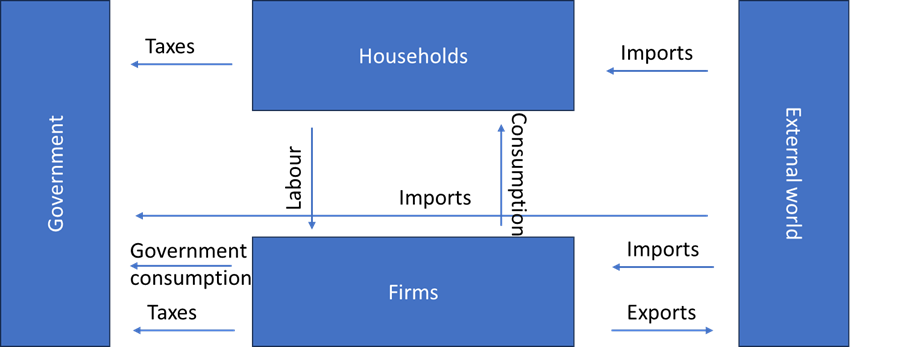
The model includes four types of agents:
- Households: They consume goods and supply labor.
- Firms: They produce goods, employ labor (demand from households), and drive investment demand.
- The Government: It collects taxes, spends on public consumption, borrows (contributing to public debt accumulation), and makes interest payments.
- International Markets: Domestic firms engage in export and import activities, where external demand is treated as exogenous.
A key feature of this model is the expanded government block, offering a more detailed analysis of government revenue, expenditure, and debt compared to the original WEFM that is especially useful for analyzing then economic consequences of additional social expenditures as outlined within the “Quality of life” pillar of the demo’s Economic Modernisation Vision. Government revenue is broken down into direct taxes, indirect taxes, customs duties, and other revenues, while expenditure is categorized into social spending (disaggregated into seven areas: education, health, housing, social protection and subsidies, labor market and jobs, arts, culture and sports, and environmental protection), other expenditures, and interest payments on debt.
Social expenditures are exogenized for scenario analysis, allowing the user to input these directly through the interface. Net lending, defined as the difference between government revenue and expenditure, and government debt, split into domestic and foreign components, are also included. Interest payments on debt are calculated separately for domestic and foreign obligations, enabling more precise fiscal policy analysis and scenario forecasting.